


Six trucks at $75,000 each.
That is $450,000 of capital sitting in a lot behind a landscaping business. Last year it earned $180,000 after tax on that capital. Forty percent.
In January, the owner buys six more trucks, another $450,000. He believes the work is coming, and he would rather own the trucks before it arrives than bid for them afterward and miss the jobs.
It takes until spring to hire the crews and until midsummer to get them productive. The new trucks earn about $23,000 of profit in their first partial year. He finishes at $203,000 on average capital of $675,000.
Thirty percent.
His original six trucks earned exactly what they earned the year before. Nothing got worse, but his return on capital fell ten points.
What matters is what the second six trucks earn in year three. If he is right, he earns $360,000 on $900,000 and is back where he started on twice the base. If he is wrong, he owns twelve trucks, six crews he can’t keep busy, and costs that pile up whether the trucks move or not.
That is the situation I see with Meta Platforms (META).
Last year, Meta earned a 40.5% return on invested capital (ROIC), among the widest spreads over the cost of capital in the S&P 500.
This year, it is spending $137 billion on its “second set of trucks”, with roughly $184 billion more planned for next year. Its invested capital is projected to rise from $193 billion to $612 billion in four years.
Five weeks ago, the market treated that spending as money set on fire. But expectations have shifted again, driven by AI-fueled ad revenue growth, the potential to earn revenue from selling compute, and the launch of Muse, its AI agent.
Even after its recent rebound, I still find Meta undervalued.
The Business
Roughly 3.6 billion people open one of Meta’s apps every day, about 44% of the 8.2 billion people on earth.
Its business model hasn’t changed in fifteen years. Give the product away, capture the engagement and the behavioral data behind it, and auction that attention to advertisers. Advertising produced about 98% of FY2025 revenue of $200.97 billion.
Meta operates two segments.
Family of Apps is the company. It produced $198.8 billion of revenue and $102.5 billion of operating income, a 52% margin.
Reality Labs produced $2.21 billion of revenue and a $19.2 billion operating loss.
Competitive Advantages
Network Effects
Social networks produce some of the strongest network effects. Users come for other users. Advertisers follow the users. As more advertisers bid, the auction gets more competitive and yield per impression rises.
An industry forecaster now expects Meta to pass Google in global digital ad revenue for the first time, $243.5 billion to $239.5 billion. That would give Meta a 26.8% market share to Google’s 26.4%. Meta is projected to grow 24.1%, Google 11.9%.
One caveat: the forecast measures net ad revenue, which deducts the traffic acquisition payments Google makes to its distribution partners. On gross reported revenue, the crossover hasn’t happened yet, but the gap has never been this narrow in fourteen years of tracking.
A twenty-two-year-old company with 3.6 billion daily users is growing revenue faster than the strongest competitor in its category. That doesn’t happen if Meta’s network effect is shrinking.
The Data Asset
Meta’s intangible assets are not its brands. Facebook’s brand is arguably a liability with anyone under twenty-five.
The real intangible assets are the behavioral dataset and the ranking models trained on it. As Mark Zuckerberg said on the June-quarter call: “people are obsessed with intelligence. But the data and the knowledge part of it to serve people well is really important.”
His claim is that model quality converges across labs, but the data flywheel doesn’t. Meta’s behavioral data matters most if frontier models become a commodity.
Advertiser Lock-In
User switching costs are low in principle and high in practice, because the social graph isn’t portable.
Advertisers have had less lock-in. They could test other platforms whenever they wanted, and they stayed on Facebook because the targeting worked. Advantage+, Meta’s automated campaign suite, is changing that.
Advantage+ has absorbed campaign setup, then targeting, then budget, and now creative generation. An advertiser who runs on that stack for two or three years probably no longer employs the people who could run campaigns by hand.
The $75 billion annual run rate flowing through Advantage+ is a lock-in metric as much as a revenue metric.
Returns on Capital
I calculate ROIC as operating profit after cash taxes, divided by the capital actually working in the business. That excludes $77.6 billion of excess cash and $27.5 billion of non-operating investments.
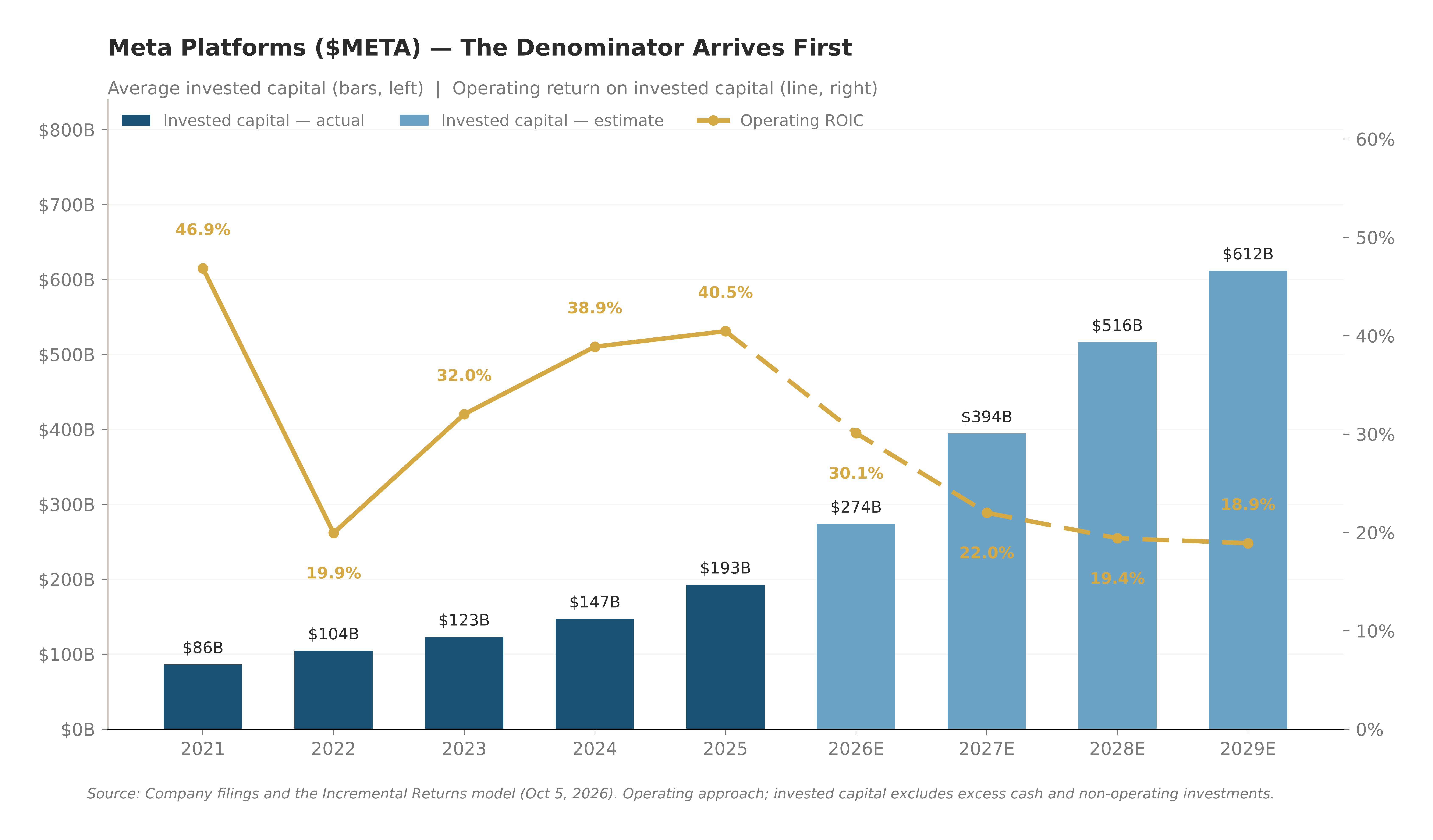
Meta’s ROIC is a margin story.
Invested capital turnover has stayed between 1.09x and 1.34x for six years, while the after-tax operating margin has ranged from 17.2% to 38.0%. Every meaningful change in ROIC came from the margin. That makes returns unusually sensitive to expense discipline, just as management is deliberately relaxing it.
ROIIC
Return on incremental invested capital (ROIIC), the profit earned on each new dollar invested, has been strong, with the three-year figure reaching 81.2% in 2025. But because the denominator uses capital from a year earlier, it doesn’t yet reflect the AI capex.
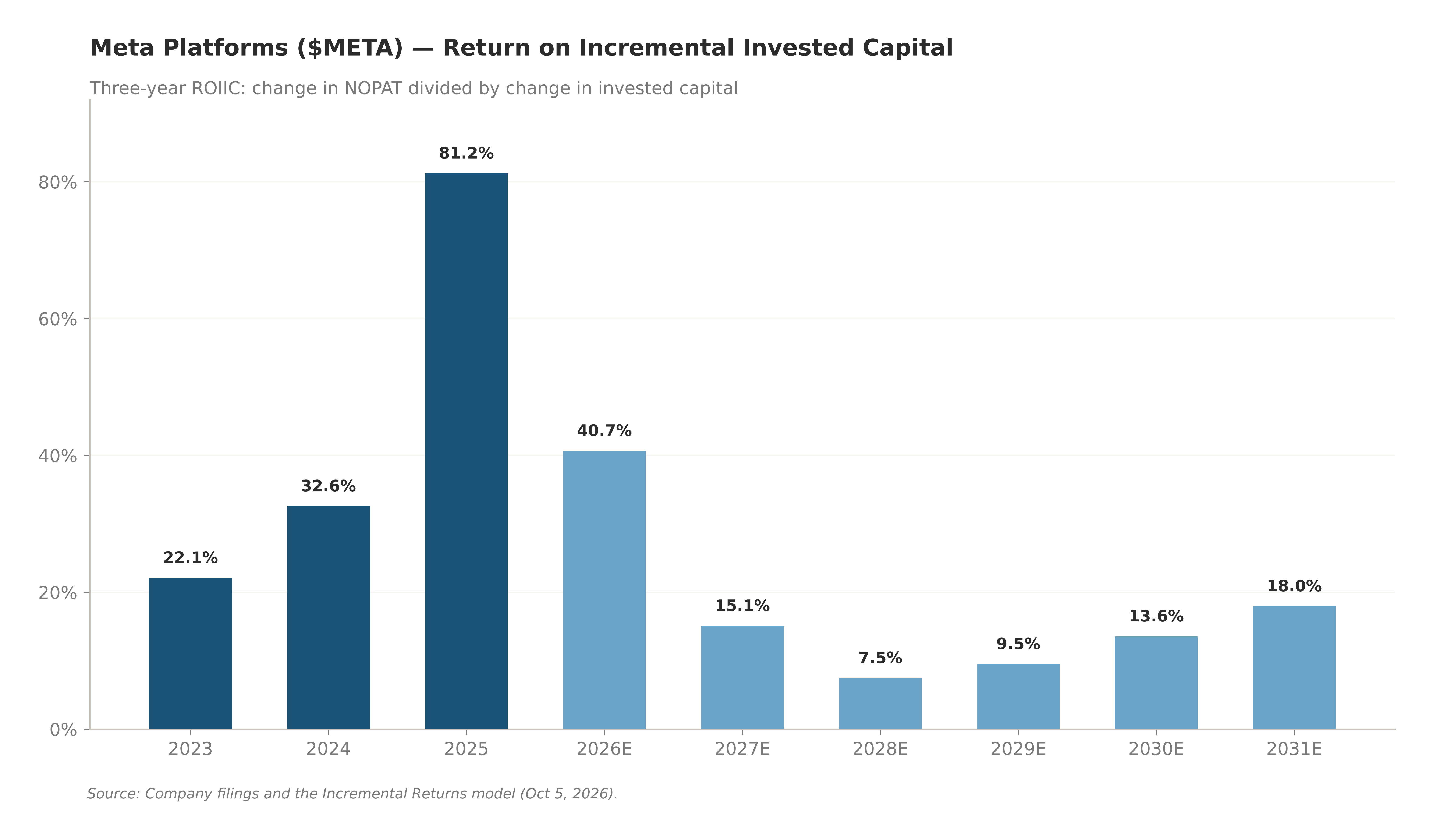
Like the landscaper, Meta is buying the trucks before the work arrives.
I expect incremental returns to decline through 2028 and 2029 before rebounding.
Capital Allocation
In the June quarter, Meta repurchased nothing and issued $25.9 billion of debt.
Meta repurchased $44.5 billion of stock in 2021 and $28.0 billion in 2022. Much of the 2022 spending came near the $90 bottom, an excellent time to buy. In each of the three years since, Meta repurchased between $20 billion and $30 billion. Diluted shares fell 10.9% from 2020 to 2025.
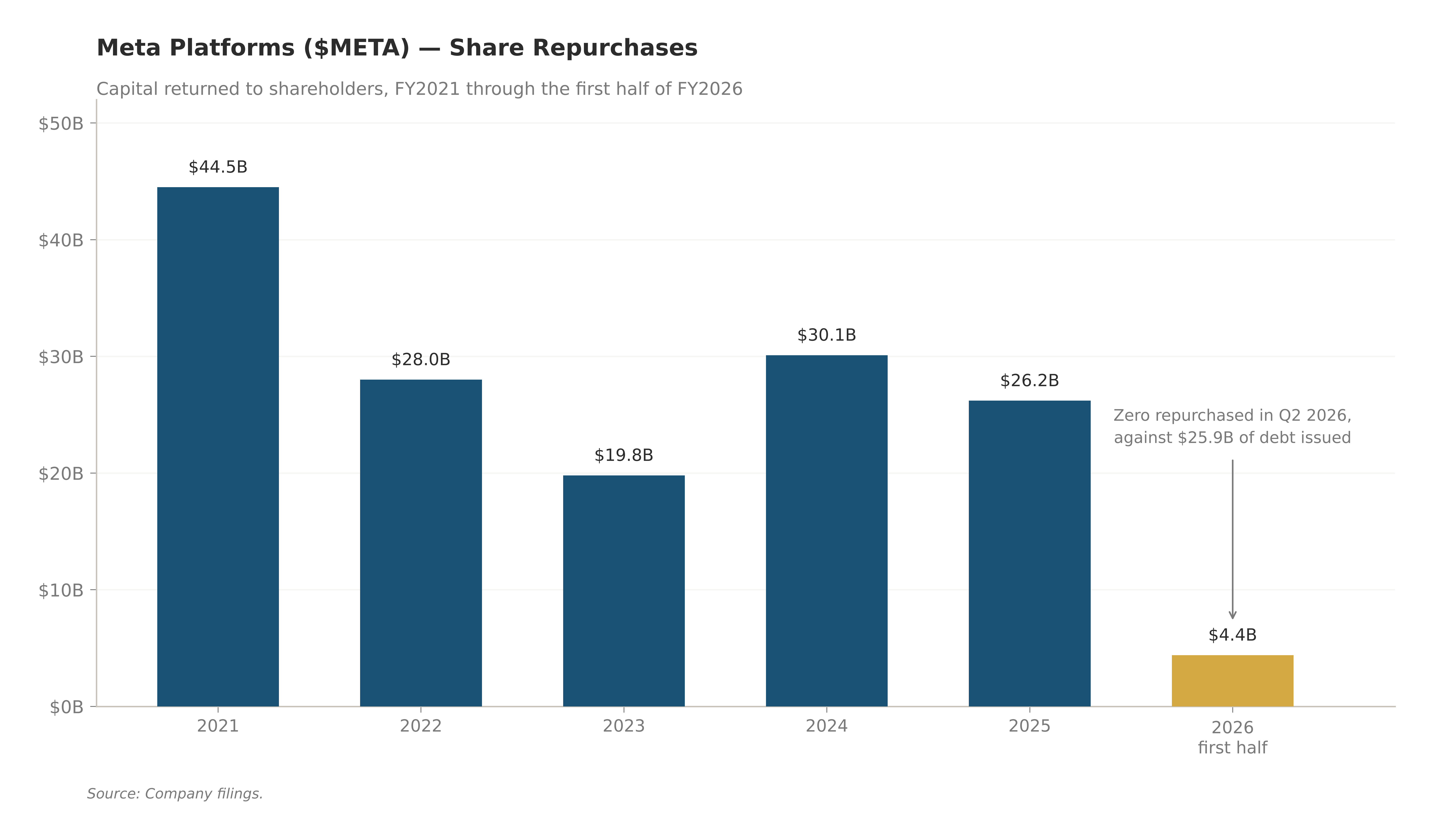
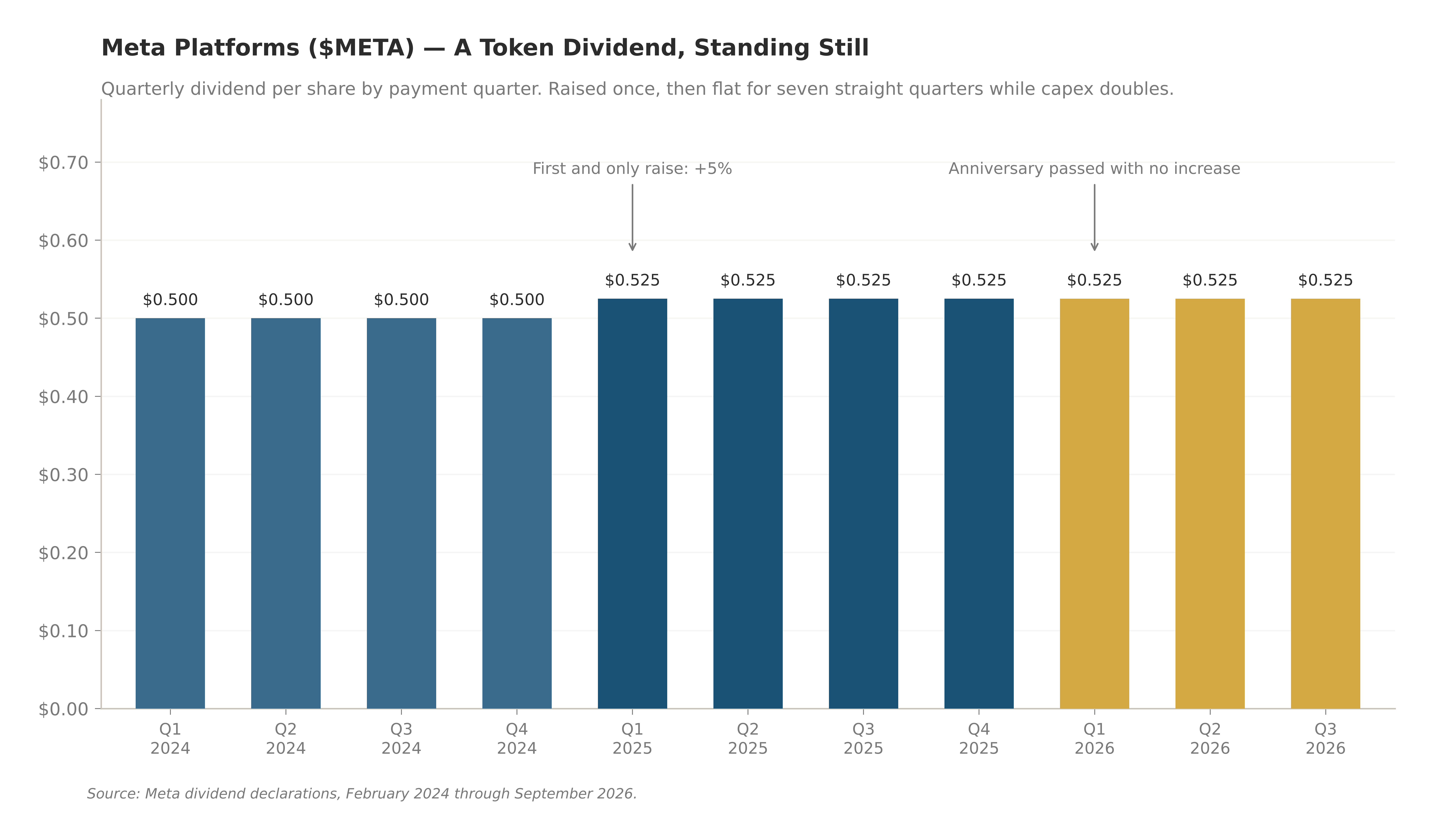
Apart from a small dividend, Meta is no longer returning capital. It’s raising it. I wouldn’t be shocked if it suspended the dividend to fund the AI buildout.
Meta hasn’t raised the dividend in more than seven quarters. Paying it costs $5.7 billion, 4.1% of expected 2026 capex.
The acquisition record is excellent. Meta bought Instagram for $1 billion and WhatsApp for $19 billion. Recent deals center on AI capability, most visibly $14.3 billion for 49% of Scale AI.
Growth Catalysts
The Ad Flywheel
Ad revenue is volume times price. Volume is users times time spent times ad load. Price is what an advertiser will pay for a conversion, which comes down to click-through and conversion rate.
AI touches every term in that equation. It keeps users on the surface longer. It decides which ad to show them. It writes the creative. It improves the odds the click becomes a sale.
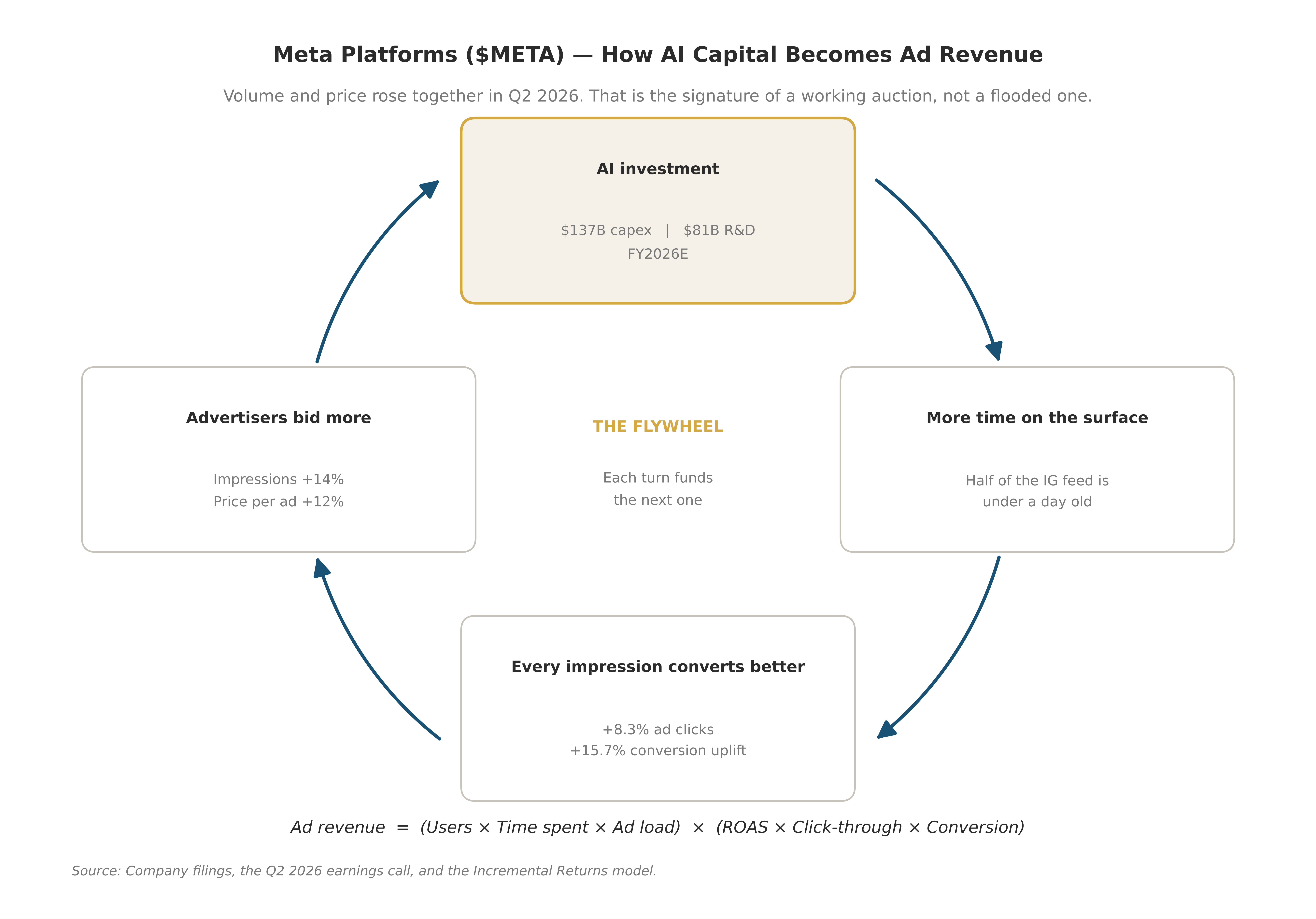
In the June quarter, impressions rose 14% and average price per ad rose 12%.