

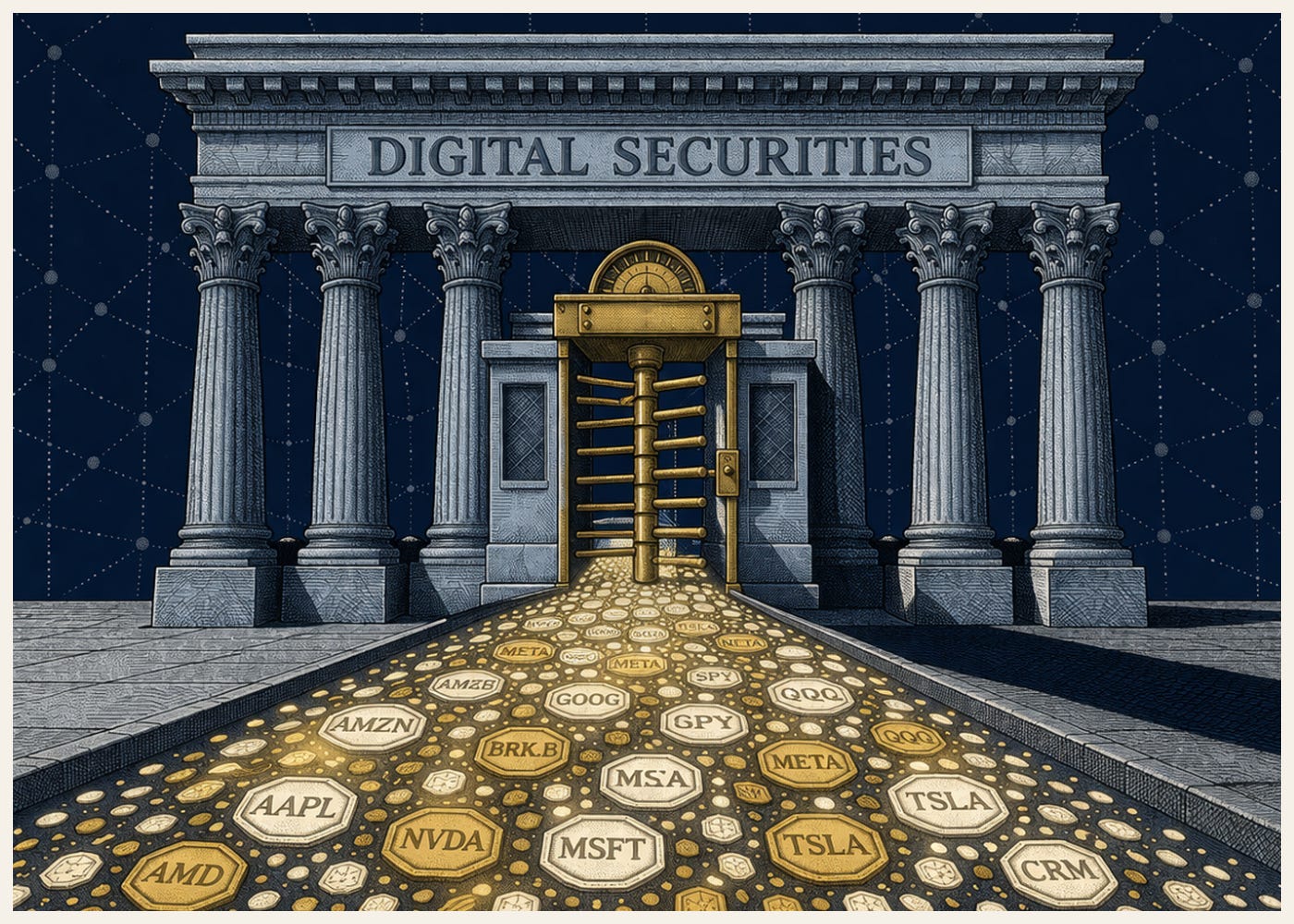
On January 19, 2026, the New York Stock Exchange announced it is building a blockchain-based platform for trading and settling tokenized versions of U.S. stocks and ETFs.
24/7 trading with instant settlement, funded by stablecoins.
Two months later, NYSE named Securitize — the BlackRock-backed tokenization firm — as its first digital transfer agent, eligible to mint blockchain-native versions of stocks and ETFs on the platform. Three weeks before that, NYSE’s parent company, Intercontinental Exchange, invested roughly $200 million in crypto exchange OKX at a $25 billion valuation, securing a board seat and a deal that will let OKX’s 120 million users trade tokenized NYSE-listed securities.
Last week, ICE completed a $600 million cash investment in prediction market Polymarket, bringing its total commitment to $1.6 billion as part of a broader $2 billion arrangement.
What’s happening here is a coordinated infrastructure play by the operator of the world’s most iconic stock exchange to rebuild market plumbing for the next era of capital markets.
For investors evaluating ICE as a long-term holding, this matters, not because tokenization will drive earnings next quarter, but because it represents asymmetric optionality that the market is currently pricing at zero.
What Is Tokenization & Why Should Equity Investors Care?
Tokenization is the process of representing ownership of a financial asset — a share of Apple stock, a Treasury bond, a unit in an ETF — as a digital token on a blockchain. The underlying asset doesn’t change. What changes is the infrastructure through which it’s recorded, traded, and settled.
Currently, when you buy a share of stock through your brokerage, the trade doesn’t truly settle for one business day (T+1). During that gap, a chain of intermediaries — clearing houses, depositories, custodians, transfer agents — reconcile records, move money, and update ownership.
Tokenized securities compress that entire process into near-instant, on-chain settlement. And they unlock capabilities the current system simply can’t offer:
24/7 trading. Global investors don’t stop wanting to trade U.S. equities at 4:00 PM Eastern. A tokenized market can operate continuously, capturing demand from every time zone.
Instant settlement. T+0 eliminates counterparty risk during the settlement window and frees up capital currently locked in the clearing process.
Fractional shares by design. Orders are sized in dollar amounts, not share quantities. A $50 investment in Berkshire Hathaway becomes trivially easy.
Stablecoin-based funding. Programmable digital cash enables settlement without dependence on traditional banking hours or wire transfer infrastructure.
The question isn’t if this will happen. It’s coming. The questions are how big will this be and, more importantly, who builds the infrastructure and gets to collect the tolls.
ICE’s Multi-Front Strategy
What distinguishes ICE’s approach from crypto-native tokenization experiments is that it’s working from a position with a structural advantage.
ICE already operates the matching engines, clearing houses, data networks, and regulatory relationships that underpin major global capital markets. It’s not building from scratch. It’s extending existing infrastructure onto new rails.
The strategy has four interlocking pieces:
1. The NYSE Digital Trading Platform
The core product. NYSE is building a new venue that supports trading of tokenized shares fungible with traditionally issued securities, as well as tokens natively issued as digital securities. It combines the Pillar matching engine — the same technology that handles billions in daily equity volume — with blockchain-based post-trade settlement across multiple chains.
Critically, tokenized shares retain full shareholder rights. This is not a synthetic derivative or a crypto wrapper. It’s a genuine share of stock, represented on-chain. That’s a fundamental distinction from every tokenized equity product currently available on offshore platforms.
ICE is also working with BNY and Citi to support tokenized deposits across its clearing houses, enabling margin obligations and funding transfers outside traditional banking hours. Launch is targeted for late 2026, pending SEC and FINRA approval.
2. Securitize: The Minting Partner
On March 24, NYSE signed an MOU with Securitize, naming it the first digital transfer agent eligible to create blockchain-native securities on the platform. Securitize — backed by BlackRock and Ark Invest, and SEC-registered — handled the issuance infrastructure for BlackRock’s tokenized fund (BUIDL). Its broker-dealer arm could participate in trading, giving it a role across both issuance and market activity.
This is where NYSE’s approach diverges from Nasdaq’s. Nasdaq recently received approval for tokenized trading, but plans to process it through traditional clearing infrastructure. NYSE is building a separate blockchain-native venue.
3. OKX: The Distribution Channel
ICE invested roughly $200 million in OKX at a $25 billion valuation, took a board seat, and established a partnership with two commercial dimensions.
First, ICE will license OKX’s spot crypto prices to launch regulated crypto futures which is a direct revenue opportunity for ICE’s exchange segment.
Second, and more strategically, OKX will offer its 120 million global users access to ICE’s U.S. futures and tokenized NYSE equities.
This solves ICE’s single biggest gap. The NYSE is the most iconic exchange brand in the world, but it has no direct distribution channel to international retail or crypto-native investors. OKX provides that channel overnight. If tokenized equities take off, ICE now has the matching engine, the regulatory framework, and the global retail distribution to capture it.
4. Polymarket: The Data Play
ICE’s $2 billion commitment to Polymarket makes it the global distributor of prediction market data to institutional investors.
In February, ICE launched the Polymarket Signals and Sentiment tool, normalizing real-time prediction market probabilities into structured data feeds.
This fits the broader strategy in two ways. First, prediction market data is a genuinely new data asset unavailable through conventional sources. Second, Polymarket runs on blockchain smart contracts, making it a natural adjacency for ICE’s on-chain infrastructure ambitions. ICE and Polymarket have explicitly agreed to collaborate on future tokenization initiatives.