


The largest cost of a mortgage is the interest rate.
Take a $400,000, 30-year loan at 7.03%. Over seven years, about how long a typical loan lasts before a sale or a refinancing, the borrower pays $188,978 in interest. Over 30 years it is $560,939.
The administration in Washington can’t set that rate. The 30-year mortgage rate follows the 10-year Treasury yield plus a spread.
The administration has tried anyway.
In January, the President said he was directing the purchase of $200 billion of mortgage bonds, using Fannie Mae and Freddie Mac’s cash, to “drive Mortgage Rates DOWN.”
I believe the reason is home equity. Mortgage holders are sitting on a record $18 trillion of it, and $11.7 trillion can be borrowed against. That is a lot of pent-up economic activity that this administration desperately needs. But a homeowner with a 3% mortgage won’t refinance at 7% to access it.
So the pressure to lower home-buying costs moved to something Washington can control. The credit score.
That score belongs to Fair Isaac (FICO).
The Lever
The Federal Housing Finance Agency (FHFA) regulates Fannie Mae and Freddie Mac. Its director, Bill Pulte, also chairs both boards.
FHFA can’t move the 10-year. It can decide what Fannie and Freddie require on the loans they buy, and for decades they required a FICO score.
No one gave much thought to what that score cost. But Fair Isaac finally gave the agency a reason to look.
The royalty on a mortgage score was about $0.60 in 2022. It is $10 today.
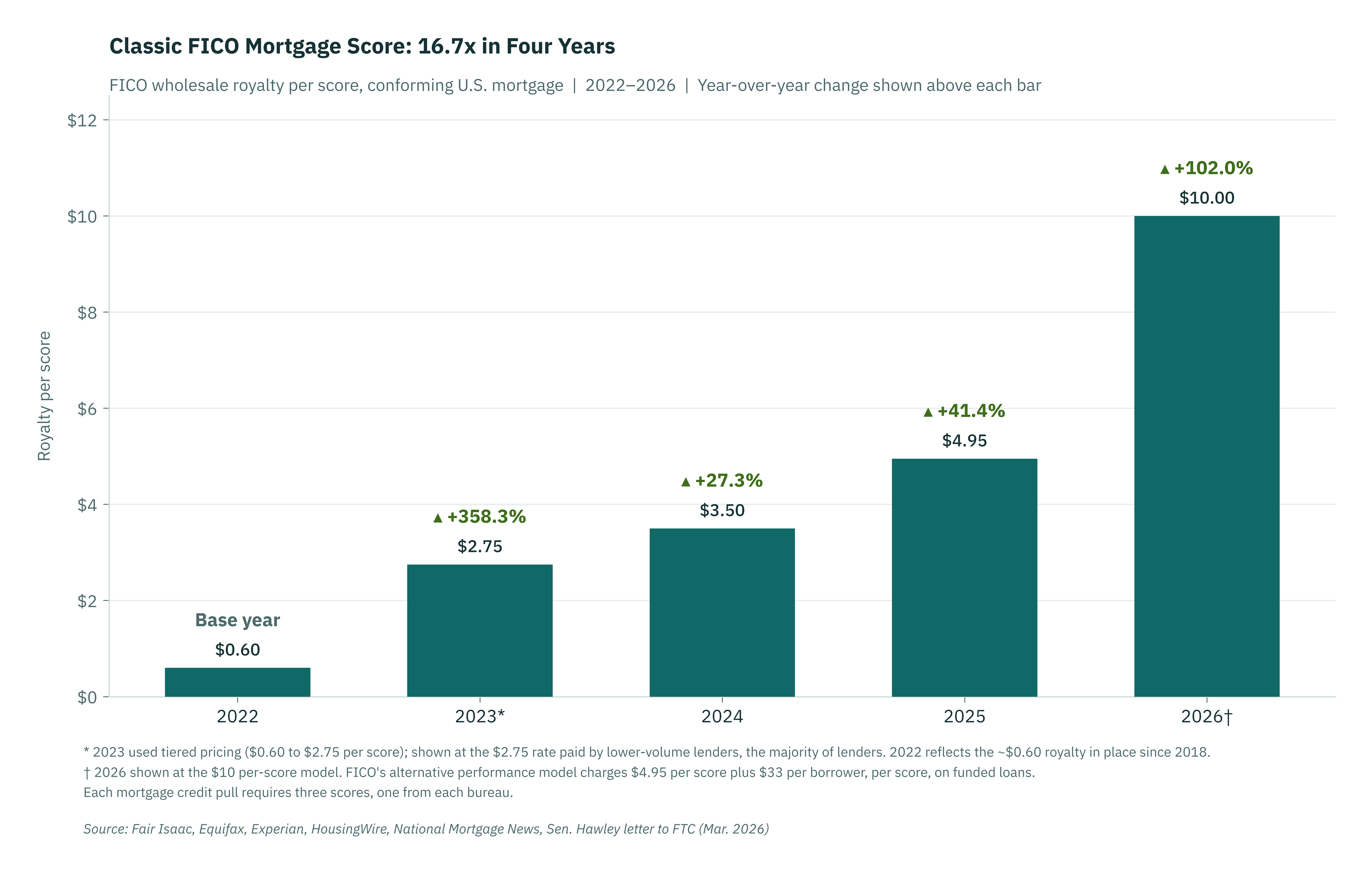
In 2023, most lenders saw the price per score rise 358%. Last quarter, mortgage score revenue grew 97% while volume grew in the low single digits. The Scores segment runs a 91% margin.
A regulator looking for someone to blame for housing costs didn’t have to look far. Even if it was looking in the wrong place.
What Scores Cost
The score is one of the smallest costs in the transaction.
On a typical conventional home purchase in 2025, the borrower’s loan costs were $5,440. Title, settlement, recording fees, and transfer taxes added $4,528.
Title and settlement alone average $2,993. Origination charges run $1,890.
A mortgage credit pull takes three scores per borrower, one from each bureau. For two borrowers at $10 a score, that is $60.
That is 1.1% of loan costs and 0.6% of everything due at closing.
Fair Isaac also now offers a performance model: $4.95 a score up front and $33 per borrower when the loan funds. On a funded loan with two borrowers, that comes to $95.70, or 1.8% of loan costs and 1.0% of the total.
Either way, the higher costs of a mortgage never appear as a line item at closing. They are built into the interest rate the borrower pays every month.
Fannie and Freddie’s guarantee fee averages about 65 basis points a year. On a $400,000 loan, that is roughly $2,600 in the first year alone. The servicer, which collects the monthly payments, keeps at least 25 basis points.
The score is the smallest of these. It is also the one the others are priced on.
Policy by Post
Policy on the scores behind the $13.12 trillion U.S. mortgage market is being made in posts on X, and the posts leave out key details.
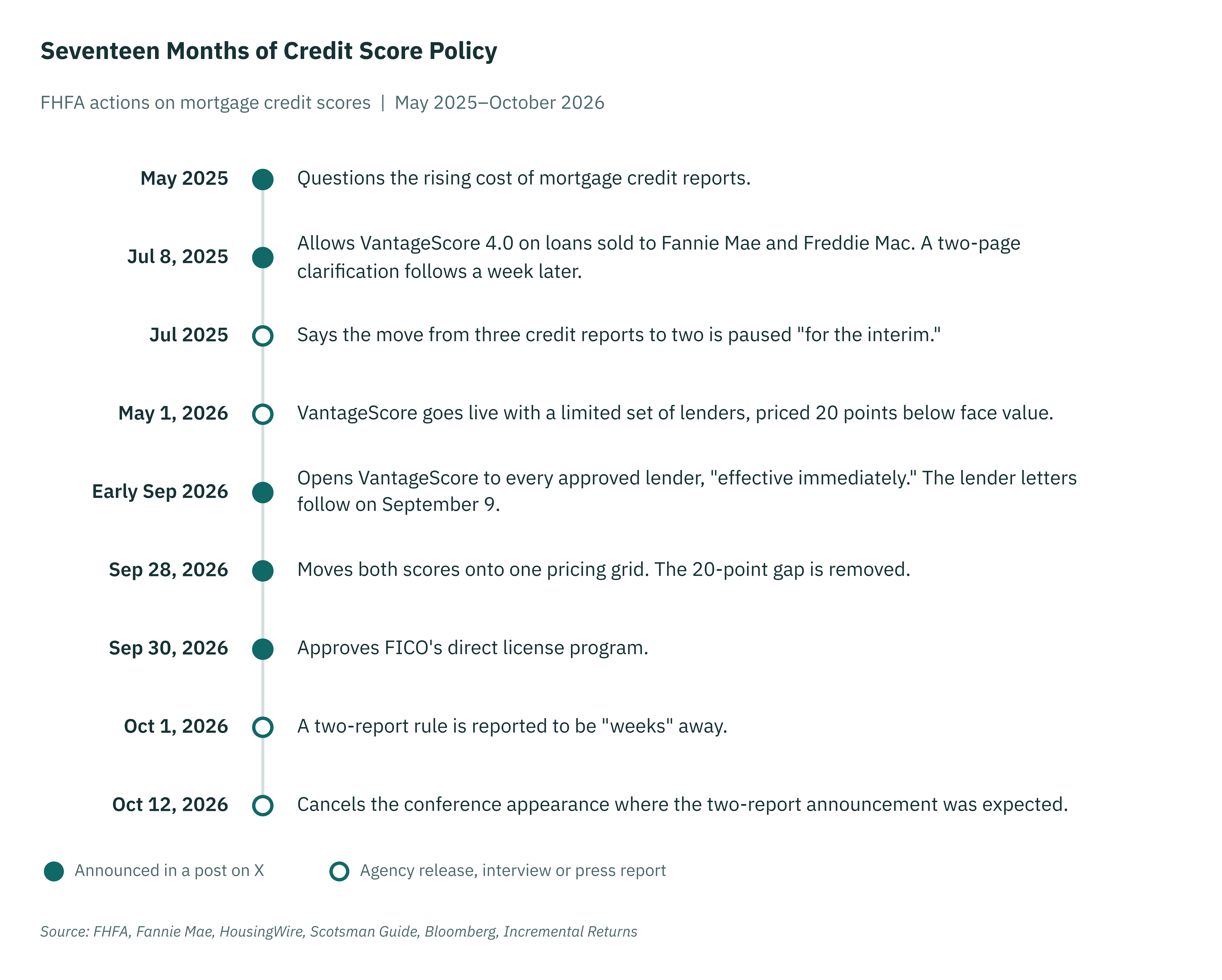
VantageScore, the rival score owned by the three credit bureaus, was allowed into Fannie and Freddie loans by a post on X in July 2025. FHFA’s written clarification came a week later.
When VantageScore went live this May, Fannie and Freddie priced it 20 points below its face value. Housing researchers at the American Enterprise Institute (AEI) find it runs about 20 points higher than FICO on average, so the haircut kept the two scores comparable.
But then on September 28, a post removed the haircut. A 720 VantageScore is now priced like a 720 FICO.
At that point, VantageScore loans had been live for five months. They were 5.5% of the loans delivered to Fannie and Freddie in September, and two lenders accounted for 95% of them.
FICO stock fell 26.5% the next day. A day after that, another post approved Fair Isaac’s plan to license its score directly to resellers.
The agency has also reversed itself on credit reports. In July 2025, FHFA paused the move from three credit reports per borrower to two, known as bi-merge, “for the interim.” This September, Pulte wrote that FHFA was “seriously considering” it. On October 1, Bloomberg reported it was weeks away. On October 12, Pulte canceled his appearance at the Mortgage Bankers Association’s annual conference, where the announcement was expected.
Policy made this way raises the risk for the company that dominates credit scoring.
The Common Language
The FICO score is the common language of risk in the mortgage market (for now).
A credit score is a measuring stick. It is worth the most when everyone in the chain reads the same number the same way: the lender, Fannie and Freddie, the mortgage insurer, and the investor who buys the bond.
The new scoring policies reward score shopping: the lender pulls more than one score and uses the highest.
United Wholesale Mortgage (UWM) now pulls both scores on every file and uses whichever is higher.
Rocket will default to VantageScore because, in its test of 1.4 million credit reports, borrowers who came out ahead saved an average of $1,600 at closing.
The savings don’t come from the price of the score. Swapping a $10 FICO score for a $0.99 VantageScore saves two borrowers $54.
Most of the savings come from the upfront fee Fannie and Freddie charge based on a credit score. Take a borrower with a 700 FICO and a 720 VantageScore. With FICO, the fee is 1.5% of the loan. With VantageScore, it is now 1.25%.
Up front, it looks great for the borrower, but it creates two new problems.
The upfront fee is what Fannie and Freddie charge for taking a loan’s credit risk. With score shopping, they collect less on a loan that is no safer. AEI estimates it cuts that fee revenue by about 13%. Fannie and Freddie can raise fees on every borrower, including the ones who never shopped a score, to make up the lost revenue. Or they can carry risk they aren’t being paid for, and the cost of that risk falls on the taxpayers who back them.
The pricing grid binds only Fannie and Freddie. Everyone else who relies on the score is free to protect themselves.
Bond investors use the score to predict how fast loans pay off, and they pay more for pools they can predict. If a 720 can describe two different borrowers, they pay less for the pool, and the lender makes up the difference with a higher rate.
Mortgage insurers and risk-transfer buyers take default risk, and they price it by score. If the score overstates the borrower, they’ll charge more.
The borrower saves money at closing, and FHFA can boast that it lowered the cost of buying a home. But in the end, the borrower pays more through a higher interest rate.
None of it is visible in mortgage spreads and rates today. VantageScore is still a small share of the scoring market. But if that share grows, the indirect costs will start to show up.
Breaking the Standard
For decades, a lender that wanted to sell a loan to Fannie Mae or Freddie Mac had to deliver a Classic FICO score with it.
That requirement is gone.