

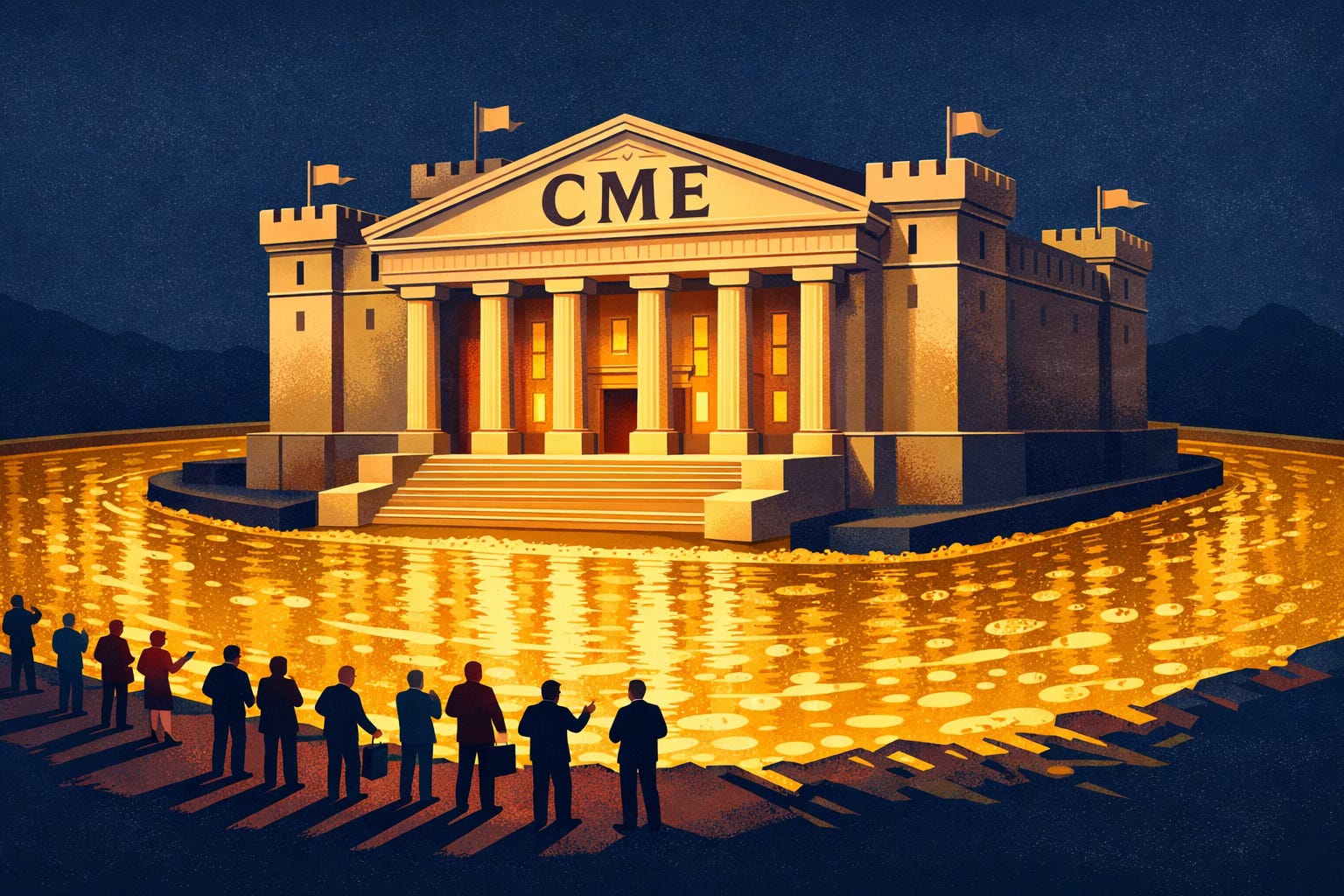
CME Group operates as the dominant force in US futures trading, controlling over 95% of interest rate futures and holding exclusive licenses for the most heavily traded equity index contracts.
This commanding position generates exceptional economics with operating margins around 60% and delivers the kind of durable competitive advantages that separate truly high-quality businesses from their peers.
Network Effects
Futures exchanges live and die by liquidity.
For traders, the ability to enter and exit positions quickly at fair prices matters far more than the transaction fees they pay. A contract with deep liquidity might cost $0.75 per trade, but poor execution on a thinly traded alternative could result in a one-tick worse price worth $15.625. This explains why traders tend to flock to the most liquid venue regardless of fee structure.
This creates powerful network effects.
Every additional trader on CME’s platform makes the exchange more valuable to the next trader by adding depth to the order book. The more participants trading 10-year Treasury futures on CME, the tighter the bid-ask spreads become and the easier it is to execute large orders without moving the market. This virtuous cycle becomes a vicious one for competitors who struggle to attract the critical mass of volume needed to offer comparable execution quality.
CME’s vertically integrated clearinghouse amplifies these network effects.
When a trader defaults on a contract, CME steps in to guarantee settlement, but the real backstop comes from the collective strength of clearinghouse members. The guaranty fund and potential assessments total nearly $22 billion, split among members. For risk management purposes, market participants prefer to concentrate their activity at clearinghouses with the largest, most financially robust membership base. This concentration makes it more difficult for new entrants to attract participants away from established venues.
Switching Costs
Futures contracts are inherently sticky.
A position opened on CME can only be closed on CME. Unlike equities that trade across multiple venues with interchangeable shares, futures contracts lock traders into the exchange where they initiated the position. This structural feature keeps CME’s liquidity pools captive and prevents traders from easily moving volume to competing platforms.
The clearinghouse structure creates additional switching friction.
For collateral efficiency, firms want to consolidate their activity at as few clearinghouses as possible. When a trader holds offsetting positions (long S&P 500 futures, short Nasdaq futures) at the same clearinghouse, they can net these positions and reduce collateral requirements. Splitting activity across multiple clearinghouses means posting more capital and managing more counterparty relationships, creating meaningful costs that discourage fragmentation.
Barriers to Entry
Multiple well-capitalized competitors have attempted to challenge CME in interest rate futures over the years. NYSE Liffe and ELX both launched competing contracts but failed to gain meaningful traction despite offering similar products at lower fees because of the formidable barriers protecting CME’s position.
New entrants face a chicken-and-egg problem. They need liquidity to attract traders, but they need traders to create liquidity. During the startup phase, early adopters must accept worse execution quality and higher implicit costs while waiting for critical mass to develop. Few market participants are willing to subsidize a competitor’s growth by accepting inferior trading conditions, especially when CME’s established platform already offers excellent liquidity.
The clearinghouse model presents another barrier.
A new clearinghouse provides minimal risk mitigation until it builds a substantial membership base. The guaranty fund that protects against member defaults scales with the number and financial strength of participants. Without an established network of members, a new clearinghouse cannot offer the same level of protection that CME provides, making it harder to attract the initial user base needed to become viable.
Intangible Assets
CME’s 27% ownership stake in S&P Dow Jones Indices.
This stake effectively guarantees exclusive access to issue S&P 500 futures contracts, the most actively traded equity index futures globally. This exclusivity also helped CME attract additional index licenses for Nasdaq and Russell 2000 futures in 2017.
The collateral efficiency advantage mentioned earlier makes these multiple index licenses particularly valuable. Traders managing portfolios of different index exposures prefer to consolidate their futures trading on a single platform. CME’s collection of the most important US equity index futures creates a gravitational pull that competitors cannot easily replicate, even if they secure licenses for individual products.
CME also generates proprietary trading data that provides unique insights into market activity and positioning. As the exclusive source for data on many products due to lack of competition, CME exercises considerable pricing power for these information services. This data monetization adds a growing, high-margin revenue stream that leverages the firm’s existing exchange infrastructure.
Why is ROIC so Low?
If CME represents such a high-quality business with powerful network effects, switching costs, substantial barriers to entry, and operating margins above 60%, why does its return on invested capital appear modest at just 11-12%?
The answer lies in two accounting realities that obscure CME’s true economic returns.
First, CME built its dominant position through strategic acquisitions of the Chicago Board of Trade (CBOT), the New York Mercantile Exchange (NYMEX), and COMEX. These deals added substantial goodwill to the balance sheet, inflating the invested capital base that serves as the denominator in ROIC calculations.
While acquisitions demand scrutiny as capital allocation decisions, CME’s purchases clearly strengthened its competitive position and expanded its economic moat. And goodwill from historical deals does not represent capital actively deployed in operations today.
Second, CME’s clearinghouses must maintain regulatory capital buffers consisting of cash and securities posted as collateral by clearing members. This capital sits on the balance sheet and can inflate invested capital figures despite not representing discretionary capital available for growth investments.
When we adjust for these factors, CME’s return on invested capital jumps to approximately 25%.
CME also requires minimal capital retention to grow. The company’s three-year return on incremental invested capital reaches 131.5% when excluding goodwill.
This exceptional incremental return profile allows CME to return virtually all its cash flow to shareholders through regular quarterly dividends supplemented by special year-end distributions.
Enduring Competitive Advantages
CME Group’s competitive advantages operate at multiple levels, reinforcing each other to create a business that is exceptionally difficult to disrupt. Network effects ensure the most liquid markets stay liquid. Switching costs keep that liquidity captive. Barriers to entry prevent new competitors from gaining the foothold needed to challenge the incumbent. Intangible assets provide exclusive access to the most valuable products and proprietary data streams.
These factors combine to produce a business capable of sustaining 60% operating margins and generating excess returns on capital for the foreseeable future.
The clearinghouse guaranty function you describe is really the cornerstone of CME's moat. The fact that CME guarantees settlement when traders default creates immense trust in the system, and that trust becomes harder to replicate than any technology. It's fascinating how this guarantee mechanism simultaneously reduces counterparty risk for participants while creating switching costs - once firms have their margin posted at CME's clearinghouse, the collateral efficiency of keeping everything there becomes a powerful retention tool.